Launching Multi-Agency Child Protection Teams on 22 June 2026
On 22 June, we will mark an important step forward in how we protect children and strengthen support for families with the launch of our Multi-Agency Child Protection Team. This is a significant moment in our reform journey and a powerful opportunity to bring together expertise from across social care, health, police and education so that children who are at risk of significant harm receive a faster, more joined-up and more effective response. The launch reflects our shared commitment to building a system that is decisive, collaborative and centred on the needs of children and families.
The Multi-Agency Child Protection Team represents more than a new way of working; it represents a new level of ambition for safeguarding in Plymouth. By bringing skilled professionals together around shared decision-making, clear thresholds and collective accountability, we can improve the quality and timeliness of protection for children while ensuring families receive the right help at the right time. As we launch our phase one on 22 June, we do so with energy, confidence and a clear sense of purpose: to create a stronger, smarter and more seamless safeguarding response that keeps children safer and supports better outcomes for families across the city.
The MACPT will hold a short Horizon meeting every weekday morning to consider the work that MACPT will be prioritising.
Phase one will be introduced incrementally while we use a phased approach ahead of full implementation by 31st March 2027. This will include the following:
LCPP role:
Chairing New strategy Meetings where they agree threshold with MASH, providing advice and guidance to families where a child abuse investigation is taking place, offering independent advice about the process and ensuring best practice is taking place and families treated with respect, honesty, fairness and transparency. Family Led Decision Making will be facilitated by the LCPP, including a visit to the family home before any Initial Child Protection Conference.
Police:
DDM’s from the MASH will support the MACPT, including attendance at strategy meetings and facilitating quality assurance as part of the MACPT team, e.g. children subject to a police protection or Emergency Protection Order.
Health: MACPT health system lead role is currently out to advert for a 12 month secondment, and the post will sit within Livewell Southwest children’s, young people’s and families’ directorate. This post will work across health providers in Plymouth providing safeguarding expertise, guiding practice and ensuring timely identification and response to safeguarding concerns.
Education:
DSLs supporting Horizon meetings, the agency follow up as part of Strategy meetings to ensure education actions progressed (if appropriate) and Consultations where required including escalations to the MACPT as per the process map and audit as part of MACPT to QA. An opportunity for a full time secondment for a dedicated education role in the MACPT is progressing.
Additional agencies are being explored to widen out the expertise and further updates will be available soon.
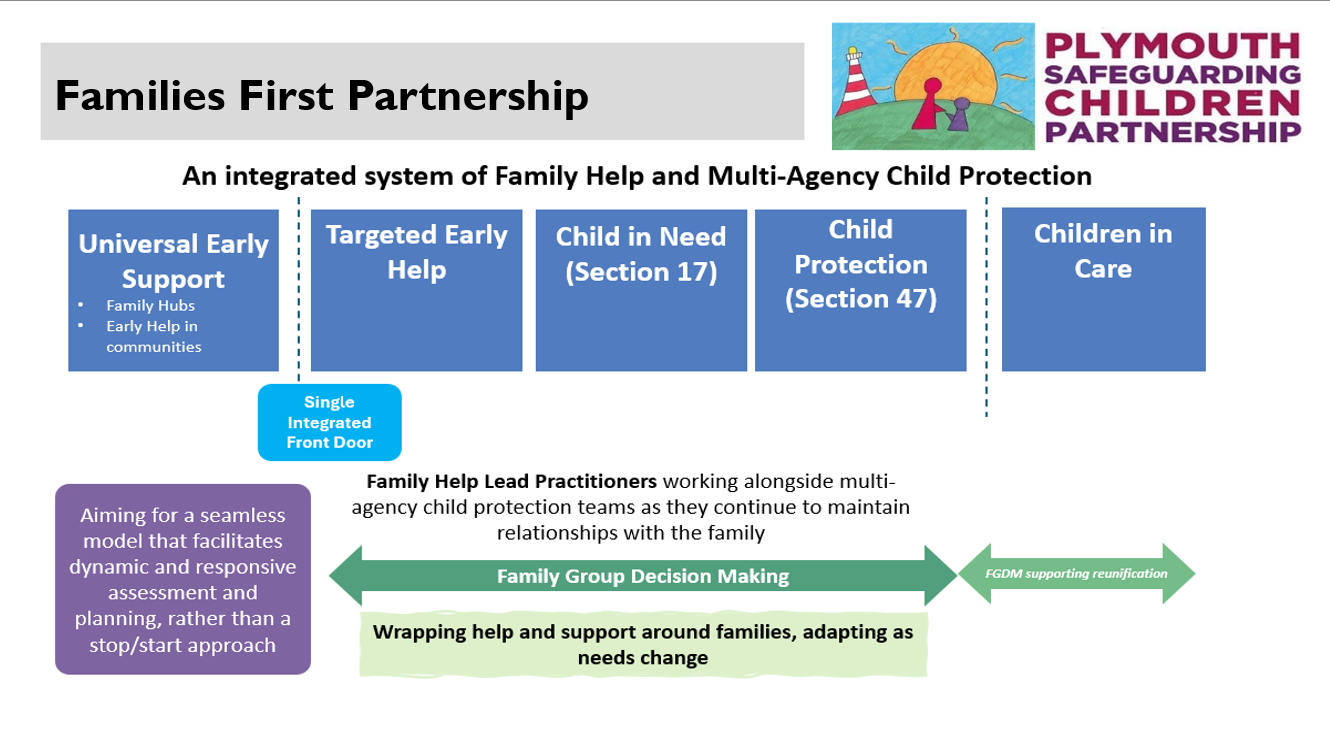
The Families First Partnership (FFP) programme sets out a system-wide reform of family support, focused on early intervention, integration, and a whole-family approach. It aims to ensure all families—regardless of background or complexity of need—can access the right help at the right time, through a connected system spanning universal, targeted, and statutory services.
The model brings together targeted early help, Child in Need, and Child Protection into a seamless continuum, with Family Help Lead Practitioners (FHLPs) maintaining consistent relationships and Multi-Agency Child Protection Teams (MACPTs) providing statutory oversight where required. Family group decision making approaches are central to the transformation – building family and community capacity to support families to thrive. The approach supports dynamic, needs-led planning and aims to reduce duplication and escalation into crisis.
This transformation requires strong local leadership, integrated workforce development, and alignment with local priorities to build a resilient, responsive system that puts children and families at the centre.
Further information can be found in the Guidance document (The Families First Partnership (FFP) Programme Guide) The Families First Partnership (FFP) Programme Guide] and on khub.net, which contains a wealth of resources from the 10 Pathfinders.

1. Reforms to Family Help
Family Help reforms represent a major step towards a seamless, integrated, whole family approach to support. It brings together targeted early help and Child in Need (CIN) services within a single, responsive continuum of support within the existing legislative framework. The focus is on flexibility, relationship-based practice, and early intervention, ensuring families get the right help at the right time, with minimal disruption or handovers between services.
At the heart of the reforms are Family Help Lead Practitioners (FHLPs) – skilled professionals (social workers or alternatively qualified practitioners) who act as the consistent point of contact for families. They lead assessment and planning, coordinate a multi-agency “Team Around the Family” (TAF), and retain the relationship even when child protection concerns arise. Their work spans from early help through to supporting delivery of child protection plans alongside Lead Child Protection Practitioners (LCPPs) and Multi-Agency Child Protection Teams (MACPTs).
Delivery of Family Help reforms requires building or expanding multi-disciplinary teams, to include co-working/co-location between a wide range of practitioners such as domestic abuse, mental health, youth justice, SEND, and housing.
Key operational changes in Family Help include:
• A single, evolving assessment and plan that follows the family, reducing duplication and ensuring continuity.
• A refreshed threshold document (to be in place by March 2026), clarifying fluid movement between levels of need and removing unnecessary gatekeeping.
• A reformed front door model with integrated triage, aligning MASH or early help contact points with Family Help services and making access more inclusive and de-stigmatised

Family Help also strengthens support around reunification, family group decision-making, and children affected by parental imprisonment. Local systems should proactively engage families in identifying their lead practitioner and reflect on lived experiences (including protected characteristics).
See Section 1 (p.16) of the Families First Programme Guide (The Families First Partnership (FFP) Programme Guide) for more detail on the full delivery expectations for Family Help.
2. Integrated Front Door
Every local area should ensure families get the right support at the right time through effective ‘front door’ systems—the first point of contact for help. These systems vary but should be:
• Integrated with Family Help
• Accessible and non-stigmatising
• Focused on timely and appropriate support
• Provide an out of hours service, to provide support outside core working time.
There is an expectation that an integrated Front Door will:
• Embed a relationship-based approach.
• Triage contacts and referrals to the right level of support.
• Connect families to universal and community services.
• Review how Multi-Agency Safeguarding Hubs (MASH) can better align with early help or other family contact points.
• Involve a broad mix of professionals, such as education, health, police and youth workers.
The Guidance provides for local flexibility for the design of the Front Door. For example, it can be virtual, physical and/or co-located with partners, and Family Hubs can act as access points. Local partnerships can determine the practitioners and agencies at the front door for example, including practitioners with expertise in:
• Special Educational Needs and Disabilities (SEND)
• Youth work
• Domestic abuse
• Child and Adolescent Mental Health Services (CAMHS)
The expectation is the front door will collaborate with the MACPT to ensure alignment for swift child protection action.
Digital platforms and social media need to be considered to enable families and practitioners to navigate services.

3. Reforms to Child Protection
The reforms aim to deliver more effective, inclusive, and responsive child protection by embedding expertise within Multi-Agency Child Protection Teams (MACPTs), maintaining strong leadership from Lead Child Protection Practitioners (LCPPs), and ensuring seamless collaboration with Family Help.
MACPTs will be expert-led teams delivering statutory child protection functions in line with Working Together and the National Framework. They will work closely with Family Help Lead Practitioners (FHLPs), who retain the relationship with the family, ensuring continuity.
There is an expectation that a MACPT will;
• Chair strategy meetings and conferences.
• Lead Section 47 enquiries and investigations.
• Oversee and reviewing child protection plans.
• Provide advice and initiating emergency action.
• Prepare for PLO or court proceedings.

MACPTs must respond to both intra- and extra-familial harm, including domestic abuse, exploitation, trafficking, and online harms. They need to tailor practice to local patterns of harm and demographics, including cultural, ethnic, and communityspecific factors. MACPT membership should include highly skilled, experienced and qualified social workers, police officers, registered health practitioners and persons with experience of education. Safeguarding partners should determine which other relevant agencies to include, e.g. probation, youth work, domestic abuse services, in line with local need.
The Lead Child Protection Practitioner (LCPP) will be a qualified, experienced social worker embedded within MACPTs. They will:
• Lead statutory decisions, chair conferences (independent of FHLPs), and bring expertise on all harm types, including extra-familial.
• Support multi-agency practice, engage families effectively, and ensure inclusive, anti-discriminatory practice.
See Section 2 (p.28) of the Families First Programme Guide for more detail on the full delivery expectations for MACPTs.
4. Family Group Decision Making (FGDM)
FGDM is a voluntary process enabling families and their wider networks to create plans that support a child’s safety and well-being, aiming to keep children safely at home and out of local authority care where possible. Family networks may include relatives, friends, or other significant people in the child’s life.
Evidence shows that children have better outcomes when they stay with their families. FGDM, especially through Family Group Conferences (FGCs), is effective in reducing the need for care proceedings and improving family-led decision-making. It empowers families with support from Family Help Lead Practitioners (FHLPs) and Multi-Agency Child Protection Teams (MACPTs), who help ensure plans are safe, legal, and meet the child’s needs.
FGDM should be integrated at all stages—Family Help, Child Protection, Care, and reunification.
See Section 3 (p.37) of the Families First Programme Guide for more detail on the full delivery expectations for Family Group Decision Making plans.
Local authorities must:
• Identify and involve the family network early.
• Offer FGDM at key decision points, especially at pre-proceedings.
• Ensure facilitators are trained and independent where needed.
• Seek the child’s and parents’ views throughout the process.
• Ensure plans are reviewed and integrated into ongoing support.
Governance
For any questions or further information, please email at:
familiesfirstpartnership@plymouth.gov.uk